Learning the Language of Scent

One of the most exciting things about writing a novel is undertaking research. For each novel, I spend a lot of time researching the setting, the history and the themes. For The Perfumer's Secret that meant visiting Paris and Venice, reading extensively about Europe and World War Two in 1939 and 1940, and delving into the world of perfume-making.
When I began writing The Perfumer’s Secret, I knew that perfume would be much more than a backdrop to the story. It would connect the past and present, bind characters together, be a vessel for their memories and ultimately become part of the mystery at the heart of the novel. But although I spent hours reading about perfume, its history and the art of creating fragrances, there was one thing I couldn't discover from a book - what it feels like to create a perfume.
A Masterclass

I went along to a perfume-making masterclass at the Experimental Perfume Club in Monmouth Street in London. As soon as I stepped into the workshop in the basement, I felt as though I had walked into Iris and Alessandro's world.
There were bottles of essential oils everywhere, alongside test strips, little glass vials, scales and notebooks. It was wonderfully reminiscent of the world I had imagined for Iris and Alessandro as they worked on their fragrances during the Second World War.
In the novel, Iris and Alessandro are travelling across Europe on the Orient Express. Officially, they are travelling to continue their work as apprentice perfumers, creating five new scents for their mentor. But there is another, far more dangerous reason for their journey - they are trying to rescue a young Jewish boy from Venice, their mentor's nephew.
The perfume-making gives them a reason to travel, but as I wrote the story I realised that fragrance is also a secret language between them, one that endures across the decades.
It was something I began to understand much better when I tried making a fragrance myself.
The Process
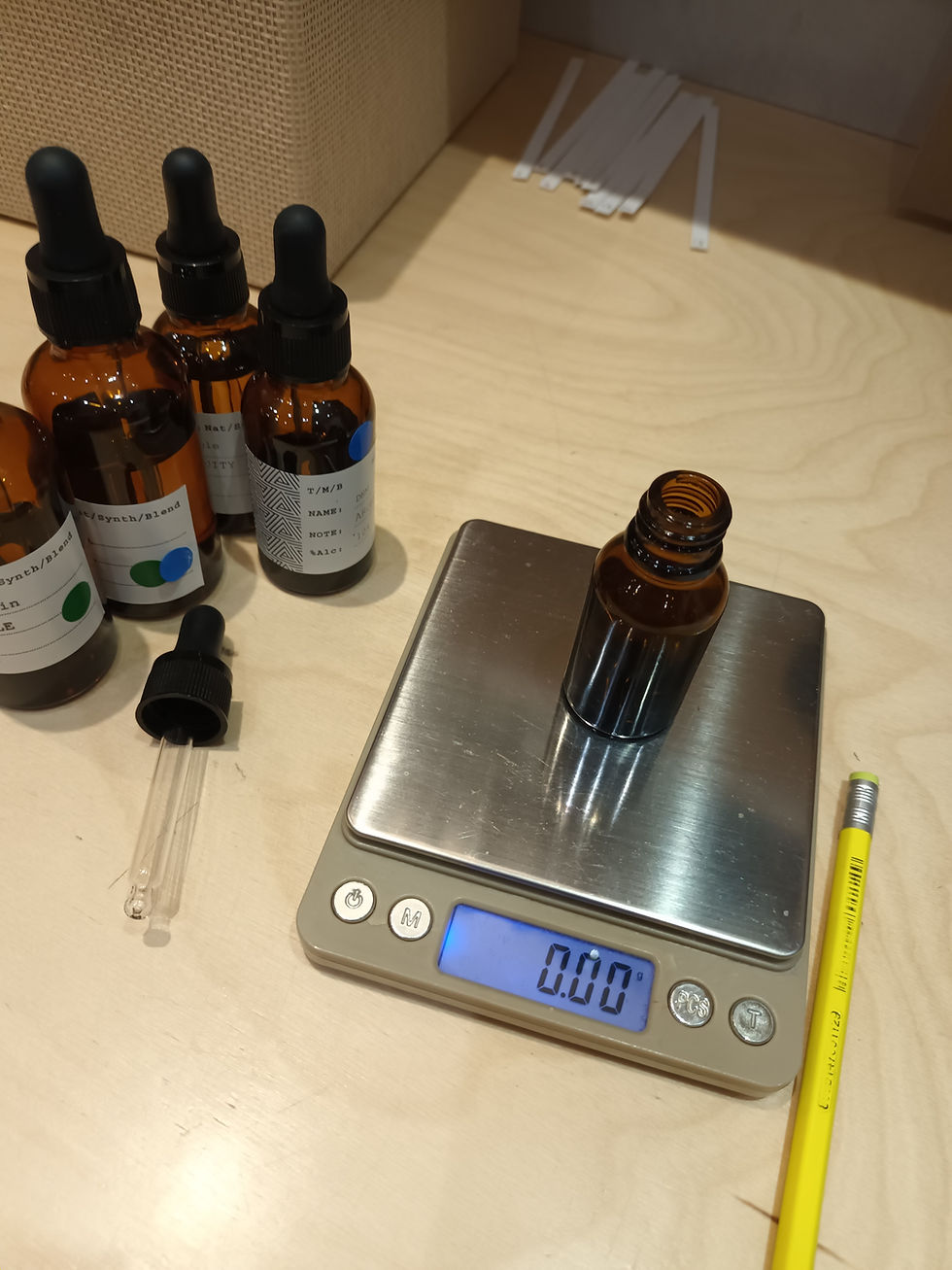
Whilst perfumes can take weeks to create, I had just one day to create two scents. Emmanuelle Moeglin, Founder & Perfumer at the Experimental Perfume Club guided a small group of us through the process of perfume making.
We sniffed a variety of raw materials to learn the lexicon of scent including: Fig Leaf, Petitgrain, Ylang Ylang, Geranium, Cedarwood, Vetiver, Frankincense and, of course, Iris, to name but a few, and then we were ready to attempt creating perfumes of our own.
The first step involved thinking of a concept for the scent: a scene, a memory or a moment.
After writing this out, we then decided on the olfactory notes:
the top note - the first hit of scent that draws you in
the heart note - the fragrance that emerges as the top note fades
the base note - the scent that lingers longest and helps define the perfume
The next step was a chance to consider the formula and estimate how many drops of each raw material we would need. This was followed by creating blends, like drafts of a story, inhaling the blend regularly and refining it until the scent matched our concept.
It was surprisingly difficult to predict what the finished fragrance would smell like from the individual ingredients, especially to someone with an untrained nose like me. Some scents that I loved on their own didn't work at all when blended together. Emmanuelle was always on hand to advise us about what would improve the scent. I felt priveleged to watch a master perfumer at work.
Writing and Perfume Making

During that unforgettable day it struck me that creating a perfume is very much like writing a story. There are the things that immediately catch your attention: the opening, the characters, the setting. Then there are deeper elements that reveal themselves as the story develops. And underneath it all are the emotions and ideas that hold everything together.
By the time we had finished, the final blends were transferred from the vials and packaged as 'real' perfumes. It seemed only fitting to call my perfumes 'Story' and 'Memory'.
Scent has such a powerful connection with memory and the stories of our lives. I've explored this in another blog post about My Life in 5 Scents. A particular perfume can suddenly a memory of something we've not thought about for years: a person, a place, or even just a brief moment.
That's one of the things that fascinated me most when writing The Perfumer's Secret.
For Stella and Bruno in the modern-day story, the fragrances created during the Second World War aren't simply perfumes. They are clues to a past that has been hidden for decades. The scents connect them to Iris and Alessandro and to events that took place decades earlier.
Do you have a scent that takes you instantly back to a particular person, place or moment?


Comments